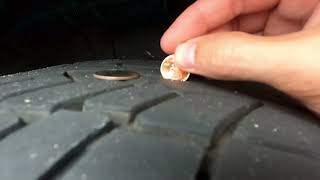
9 Tire Shop Things Destroying Your Tires (And 4 Places That SAVE Them), by Tarmac Hub on YouTube. 15 min 58 s.
- Video length
- 15 min 58 s
- Time to do it
- 15 minutes
- Difficulty
- Easy
- Steps
- 8
What you need
Steps
Park on flat ground and let the tyres cool. Check the door jamb placard or owner's manual for the correct pressure, then set all four tyres to that figure.
Push a tread depth gauge into the main grooves at three points across each tyre: inner edge, centre and outer edge. Write down each reading.
Compare the readings. Anything at or near 1.6 mm is the legal limit and needs replacing. Uneven wear between inner and outer edge points to alignment trouble.
Find the DOT code on the sidewall. It ends in four digits: the first two are the week of manufacture and the last two are the year.
Read the date code on all four tyres. If any tyre is more than about six years old, plan to replace it even if the tread looks fine.
Check the valve stems for cracks or perishing rubber. Ask for a new valve stem kit whenever a tyre is fitted.
Look for mismatched tread depths across the same axle. Keep pairs on an axle within about 2 mm of each other.
Ask the shop for a printout of the alignment readings before and after any alignment. If they cannot show you numbers, go elsewhere.
Tips and common mistakes
A tyre ages whether you drive it or not, so a low mileage tyre can still be too old to trust.
Ask the shop to torque the wheel nuts with a torque wrench rather than an impact gun, then recheck them after 50 km.
Never let a shop mount a tyre dry. Ask them to use mounting paste so the bead seats without damage.
Keep your own written record of tread depth and date codes so you can spot changes at the next visit.
Questions
Where is the date code on a tyre?
It is stamped on the sidewall after the letters DOT, usually in an oval panel. The last four digits are the week and year of manufacture, for example 2324 means week 23 of 2024.
What tread depth is legal?
In the UK the legal minimum is 1.6 mm across the central three quarters of the tread. Many drivers replace tyres at around 3 mm for better wet grip.
Do I need nitrogen in my tyres?
No. Normal air is about 78 percent nitrogen already. Check your pressures monthly with a gauge and top up with air.
This guide was drafted from the video's details and general task knowledge. It has not been checked against the full video. Check the video and relevant product instructions before following a procedure. Report a correction.