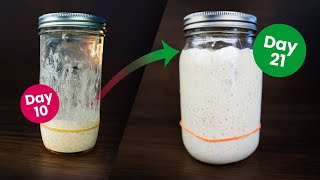
Bake a crusty, airy sourdough loaf using a starter you did not have to grow yourself. It suits anyone who can weigh ingredients and wait between folds. You need an active starter that doubles after feeding, plus a Dutch oven for the best crust.
YouTube video: You can make sourdough bread at home too! 🍞Don’t worry I got you! #homemade #breadbaking #sourdough
Caption availability is unknown. Check the CC control in the YouTube player.
- Video length
- 1 min 1 s
- Time to do it
- 4 hours plus overnight proof
- Difficulty
- Medium
- Steps
- 9
What you need
Steps
Feed your starter the night before with equal weights of starter, flour and water, about 50 g each. Cover it and leave it out until it doubles and looks bubbly.
Weigh 500 g bread flour and 350 g water into a large bowl. Mix until no dry flour is left, then rest 30 minutes so the flour hydrates.
Add 100 g of the bubbly starter and 10 g salt. Squeeze and fold the dough with wet hands until everything is evenly combined.
Do four sets of stretch and folds, 30 minutes apart. Wet your hand, lift one side of the dough, fold it over, turn the bowl and repeat four times.
Let the dough bulk ferment at room temperature for 2 to 3 hours after the last fold. It is ready when it looks puffy and jiggles when you shake the bowl.
Tip the dough onto a lightly floured counter, shape it into a round and rest 20 minutes. Then shape it tight and place it seam side up in a floured banneton.
Cover and chill the dough in the fridge for 8 to 12 hours. This slow proof builds flavour and makes scoring easier.
Heat the oven and Dutch oven to 250C, about 480F, for at least 30 minutes. Turn the cold dough onto parchment, score the top and lower it into the hot pot.
Bake covered for 20 minutes, then uncover and bake 20 to 25 minutes more at 230C until deep brown. Cool on a rack for at least an hour before slicing.
Tips and common mistakes
Weigh everything on a scale, since cup measures shift the water level and change the crumb.
Score with a sharp blade and keep your hand behind it, and use dry gloves when moving the screaming hot Dutch oven.
If the starter does not double after feeding, feed it again and wait rather than baking with it.
A dense loaf usually means the bulk ferment was too short, so give the dough more time next bake.
Questions
How do I know my starter is ready to bake with?
It should double in size within 4 to 8 hours of feeding and have plenty of bubbles on top. A spoonful should float in a glass of water.
Can I bake this without a Dutch oven?
Yes. Bake the loaf on a hot tray and put a metal pan of water on the shelf below to make steam. The crust will be a little less crisp.
Why did my loaf come out flat?
The dough was probably over proofed or shaped too loosely. Watch for a puffy, jiggly dough and build a tight skin before the cold proof.
The notes are drafted automatically from video details and general task knowledge. How the guide was prepared
Report a correction