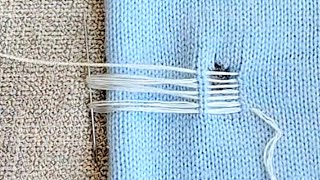
Backstitch is one of the strongest hand stitches you can sew, and it works well on seams that take stress like armholes and shoulders. This guide suits beginners and anyone sewing by hand who wants a sturdier seam. You only need a needle, thread and fabric.
YouTube video: Hand Sewing Tutorial (LEFT HANDED): Backstitching
Caption availability is unknown. Check the CC control in the YouTube player.
- Video length
- 5 min 31 s
- Time to do it
- 15 minutes
- Difficulty
- Easy
- Steps
- 8
What you need
Steps
Thread your needle and knot the end of the thread. Use a single or double strand, depending on how thick you want the seam.
Push the needle up through the fabric from the back at the start of your seam line. Pull the thread through until the knot sits against the fabric.
Make one small forward stitch by pushing the needle down a short distance ahead, about 3 to 5 mm. Pull the thread tight.
Bring the needle back up through the fabric one stitch length behind where you just came out. This leaves a small gap between the new stitch and the last one.
Push the needle down again just ahead of your first stitch, keeping the same stitch length. Pull the thread through.
Repeat this back and forward motion along the whole seam line. Each new stitch should start where the previous one ended so the line stays even.
Keep your tension steady but not too tight. The fabric should lie flat without puckering as you sew.
Finish by taking the needle to the back of the fabric and making two small stitches on top of each other to lock the thread. Trim the thread close to the fabric.
Tips and common mistakes
Keep your stitch lengths even so the seam looks neat and holds well.
Do not pull the thread too hard or the fabric will pucker along the seam.
Practice on a scrap of fabric first to get the back and forward rhythm.
Use a thread colour that matches your fabric so small mistakes are less visible.
Questions
Is backstitch stronger than running stitch?
Yes. Backstitch overlaps each stitch, so it holds up better on seams that take stress, like armholes and shoulder seams. Running stitch is faster but weaker.
How long should each backstitch be?
Aim for about 3 to 5 mm per stitch. Shorter stitches give a stronger seam, while longer stitches are quicker but less secure.
Can I use backstitch for a whole garment?
You can, and it is a good choice for stress seams. For long straight seams you may prefer a running stitch for speed, then backstitch the areas that get pulled.
The notes are drafted automatically from video details and general task knowledge. How the guide was prepared
Report a correction